

Table of Contents
- Why Material Integrity Matters in Textile Design
- Natural vs Synthetic Fiber Characteristics
- How to Check Fabric GSM and What It Tells You
- Identifying High-Quality Printing on Fabric
- Visual Cues That Reveal Textile Integrity
- What Visual Checks Miss: Lab Testing and Certifications
- Frequently Asked Questions
Last Updated: September 25, 2026
Why Material Integrity Matters in Textile Design
Identifying quality materials in textile design starts with understanding that fiber composition, yarn density, and finishing processes determine how a fabric performs over years of use, not just how it looks on a shelf. At MargoLouisoDesigns, every collection begins with original artwork, and genuine materials matter as much as legitimate design. This guide covers the visual checks, technical benchmarks, and lab-verified standards that separate durable textiles from disposable ones. Only you can determine whether to choose a high quality long lasting more expensive product as an investment piece or a less expensive temporary "I go with the trends or my moods" kind of splashy easy to replace bling! Or something in between? Match each POD (Print on Demand) company against your individual needs.
Natural vs Synthetic Fiber Characteristics
Natural fibers come from plants or animals; synthetic polymers are manufactured from petrochemical or bio-based sources. Each behaves differently in breathability, moisture management, and aging.
How Natural Fibers Age and Perform
Cotton, linen, wool, and silk develop character with use: linen softens with every wash, wool regulates temperature and resists odor. The trade-off is that natural fibers can shrink, wrinkle, or fade if finishing is poor. Staple length matters enormously, longer cotton staples produce stronger, smoother yarn with less pilling, while short-staple cotton sheds fibers and wears thin at stress points.
Where Synthetic Polymers Fit in Interior and Wearable Textiles
Polyester, nylon, and acrylic offer abrasion resistance and dimensional stability natural fibers can't match alone; for daily-use upholstery, a polyester blend often outlasts pure linen. The problem is when synthetics cut costs rather than add performance. Low-grade polyester traps moisture, pills quickly, and holds static, while higher-quality synthetics, especially recycled variants, can rival natural options in moisture management and breathability.
How to Check Fabric GSM and What It Tells You
Fabric GSM (grams per square meter) is a textile's weight per unit area, directly indicating density, durability, and appropriate use. Lightweight cotton voile sits around 70-100 GSM; heavy upholstery canvas can exceed 400 GSM.
|
Fabric Type |
Typical GSM Range |
Best For |
|---|---|---|
|
Sheer voile |
70-100 |
Curtains, layering |
|
Standard shirting |
110-140 |
Clothing, light bedding |
|
Denim |
300-450 |
Jeans, heavy jackets |
|
Upholstery canvas |
350-500 |
Sofas, cushions, bags |
Identifying High-Quality Printing on Fabric
High-quality printing on fabric is defined by dye penetration, colorfastness, and pattern registration, not by how vivid colors look in a product photo. A print sitting on the surface will crack, peel, or fade within a few washes; one bonded with the fibers will hold.
Check these three things:
- Dye penetration: Look at the reverse side of the fabric. On a quality print, you should see faint color showing through, indicating the dye reached the fibers, not just the surface.
- Colorfastness: Rub a damp white cloth firmly across the printed area. If color transfers to the cloth, the print will bleed in the wash.
- Pattern registration: On multi-color prints, edges between colors should be sharp, not blurry or misaligned. Misregistration signals low-precision equipment and poor quality control.
Visual Cues That Reveal Textile Integrity
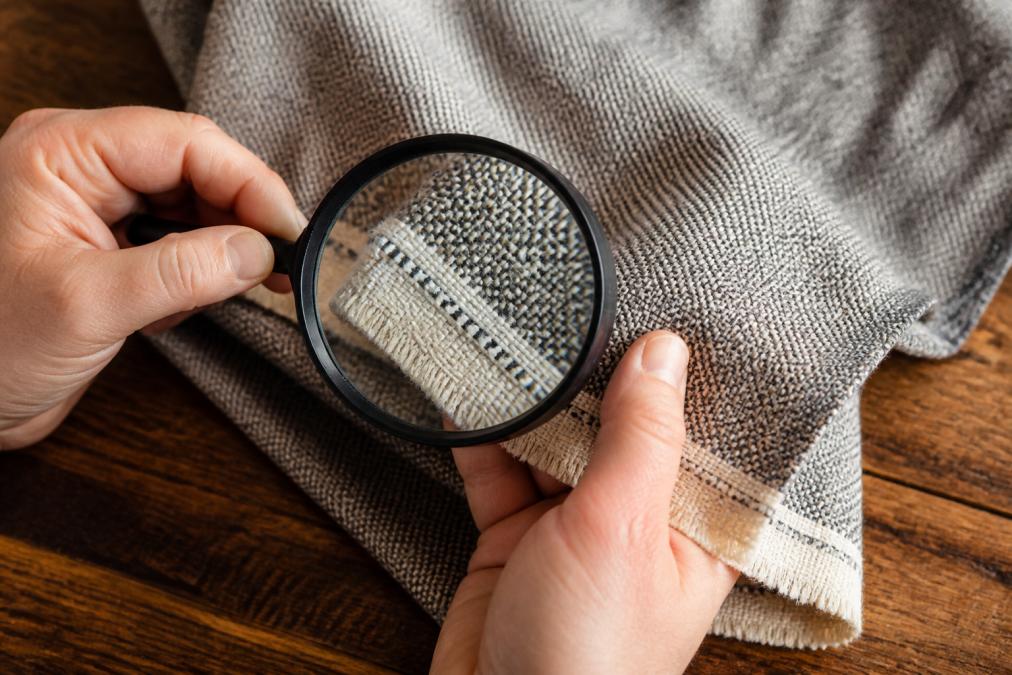
Textile integrity is a fabric's ability to hold its structure, color, and hand-feel through repeated use and washing. You can assess most of it with your eyes and hands before spending a cent, but only if you know what the structure is telling you. The most useful first distinction is woven versus knit, because the two fail in completely different ways.
Woven vs. Knit: The Structural Fork
Woven fabrics interlace warp (lengthwise) and weft (crosswise) yarns at right angles: they resist stretching, ravel at cut edges, and hold a crisp shape, denim, canvas, shirting, upholstery. Knits loop yarns through one another: they stretch, recover, and resist wrinkling, but snag and run, jersey, ribbing, fleece, swimwear.
Weave Structure, Drape, and Hand-Feel
Hold the fabric up to light: a tight, even weave shows consistent spacing with no visible gaps or slubs. Plain weave (over-one, under-one) is tightest and most stable but least drapey; twill (diagonal lines, as in denim) is denser and more abrasion-resistant; satin (long floats) is smooth and lustrous but snags easily because yarns sit on the surface.
Selvage, Yarn Density, and Ply
The selvage is the finished edge of a woven fabric and one of the most honest quality indicators. A clean, tight selvage with no fraying suggests careful manufacturing; on better goods it often carries the mill's name, fiber content, and sometimes a production code, a small but real traceability signal.
Beware of inflated thread count claims. Some manufacturers count multi-ply yarns as individual threads, doubling or tripling the number on the label. If a thread count seems impossibly high for the price, it's likely a marketing figure, not a quality signal.
A quick field test for weave consistency: hold the fabric against a bright window and look for a uniform grid. Irregular gaps, thick-and-thin yarns, or visible slubs mean the yarn was spun unevenly, a defect that will show up as pilling and thin spots within a few washes.
What Visual Checks Miss: Lab Testing and Certifications
Visual inspection catches obvious defects, but lab testing reveals what the eye cannot: fiber composition accuracy, tensile strength, abrasion resistance, pilling tendency, and harmful chemicals. A fabric can look flawless and still fail on dimensional stability or dye penetration at the molecular level, the layer most beginner guides skip, and where professional textile evaluation lives.
Field Tests You Can Run Yourself
You don't need a lab to get closer to the truth. Three simple tests separate fiber categories and expose weak construction:
- Burn test. Pull a few yarns from a hidden seam or selvage and burn them over a fireproof surface. Cellulosic fibers (cotton, linen, rayon) burn like paper, smell like burning leaves, and leave soft gray ash. Protein fibers (wool, silk) smell like burnt hair and form a crushable black bead. Synthetics (polyester, nylon, acrylic) melt, smell chemical, and leave a hard plastic bead that won't crush. Blends show mixed behavior, a useful tell when a label claims "100% cotton."
- Fiber identification by hand. Untwist a yarn and look at the individual fibers. Long, uniform filaments suggest synthetic or silk; short, fuzzy staples suggest cotton or wool. Staple length is one of the strongest predictors of pilling and wear.
- Abrasion and pilling check. Rub the fabric against itself or a rough surface for 30 seconds. Loose surface fibers that ball up quickly signal a fabric that will pill in the wash. Rub a damp white cloth across the surface to check colorfastness, transfer means the dye will bleed.
What Laboratory Standards Actually Measure
When a mill or brand cites lab testing, these are the usual standards:
- Martindale abrasion (ISO 12947): Measures how many rub cycles a fabric survives before wearing through. Upholstery typically targets 20,000-40,000 cycles for domestic use and higher for contract use.
- Pilling (Martindale or ICI pilling box): Rates surface fuzz and pill formation on a 1-5 scale, where 4-5 is good.
- Dimensional stability (AATCC or ISO wash tests): Measures shrinkage after laundering. Anything above roughly 3-5% on a woven is a warning sign for garments.
- Colorfastness to light, wash, and rub (ISO 105 series): Rates fading and transfer on a gray scale. Higher ratings mean the color will survive real-world use.
- Tensile and tear strength (ASTM D5034, D5587): Predicts how a fabric behaves under stress at seams and stress points.
Reading Certifications as a Quality Proxy
Certifications bridge the gap between what a brand claims and what a textile delivers. They don't guarantee beauty, but they verify specific claims about chemistry, fiber origin, and process control:
- OEKO-TEX Standard 100: Verifies the finished textile is tested for harmful substances at levels considered safe for human health, including for baby articles at the strictest class.
- GOTS (Global Organic Textile Standard): Confirms organic fiber content and responsible processing across the supply chain, with social and environmental criteria.
- GRS (Global Recycled Standard): Verifies recycled content claims and tracks them through production.
- ISO 9001: Indicates the manufacturer follows a documented quality management system, a process signal, not a product one.
- REACH compliance: Ensures chemical safety for textiles sold in the EU market.
Cost-to-Quality Ratio: When High Quality Is Actually Necessary
Not every garment needs 40,000-cycle upholstery-grade fabric. The professional move is matching material investment to the use case:
- High-contact, long-life goods (sofas, workwear, everyday bags): pay for abrasion resistance, colorfastness, and certified chemistry. The cost-per-year math favors the higher-priced, tested material.
- Low-contact or short-cycle goods (seasonal fashion, occasional wear, decorative pillows): mid-tier materials are often rational. A cheap textile replaced yearly costs more over five years than a well-made one lasting a decade, but only if you keep it that long.
- Art-led or print-driven pieces: prioritize dye penetration and colorfastness over abrasion numbers, since the print is the point.
Post-Production Aging: What to Expect Over 50+ Washes
Quality is also a prediction about time. Fibers degrade on different curves:
- Cotton softens and may shrink slightly in the first few washes, then stabilizes. Long-staple, two-ply cotton holds shape far longer than short-staple single-ply.
- Linen gets softer and more supple for years, but can thin at fold lines and stress points with heavy use.
- Wool resists odor and holds shape but can felt or pill if washed incorrectly; quality wool recovers its loft after wearing.
- Silk loses luster with harsh detergents and prolonged sun exposure; hand-washing and low heat preserve it.
- Polyester and nylon hold color and shape but can pill, snag, and accumulate odor; higher-quality recycled variants perform closer to natural fibers.
Frequently Asked Questions
How do I identify fabric quality by touch and sight?
Rub the fabric between your fingers: quality materials feel dense and spring back rather than staying compressed. Hold it to light to check weave density, look for even dye penetration, and inspect seams for tight, consistent stitching. A fabric with high yarn density and tight weave structure will resist pilling and hold its shape longer than a loose, thin weave.
What GSM should I look for in home textiles and clothing?
GSM (grams per square meter) tells you fabric weight and density. Lightweight fabrics sit around 100-200 GSM, medium-weight around 200-350 GSM, and heavy upholstery or outerwear above 350 GSM. For home decor like throws or cushion covers, 250-400 GSM gives good durability. For clothing, 150-250 GSM works well for year-round wear. Always match GSM to intended use rather than assuming higher is always better.
How can I tell if a printed design on fabric is high quality?
Press a damp white cloth against the print and rub gently. If color transfers, the dye penetration is poor and colorfastness is low. Quality printing shows sharp edges with no bleeding, consistent color across the full pattern, and no cracking when you stretch the fabric. On original artwork designs, look for fine detail retention: if small lines or subtle gradients are visible and crisp, the printing process preserves the art well.
What are the most durable natural fibers for interior design?
Linen, hemp, and tightly woven cotton lead for durability in home textiles. Linen has high tensile strength and improves with washing. Hemp resists abrasion and UV damage. Cotton with a long staple length and tight weave holds up well. Wool offers natural stain resistance and thermal regulation. Each fiber has trade-offs: linen wrinkles, cotton can shrink, and wool needs careful cleaning. The weave structure and finishing processes matter as much as the fiber itself.
0 comments